Possible solutions to local weather impacts of large wind farms
New research indicates that large-scale wind farms may influence local weather.
It suggests the impact can be minimised by changing the design of the rotors or
positioning wind farms in regions with high natural turbulence. These strategies
could also make the farms more productive.
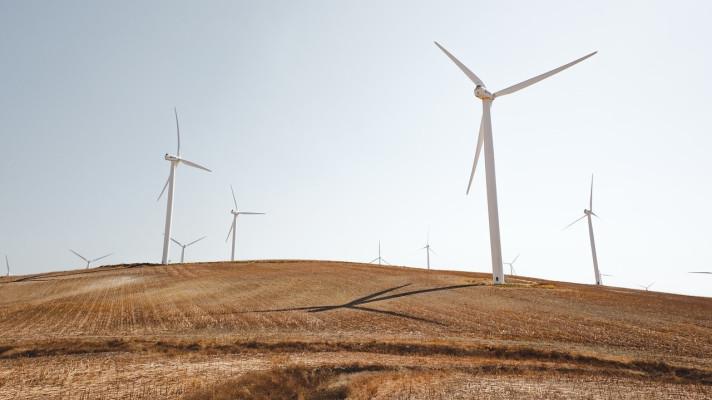
New research indicates that large-scale wind farms may influence local weather. It suggests the impact can be minimised by changing the design of the rotors or positioning wind farms in regions with high natural turbulence. These strategies could also make the farms more productive.
Wind power could be a part of the solution to tackle climate change and all large industrial economies feature wind power prominently in energy plans. However, many modelling studies suggest that wind farms can affect local-scale weather. These assumptions have not been tested with real wind farms, so this study compared modelled results with real data from a US wind farm in the foothills of the San Jacinto Mountains in California.
Data from the wind farm indicated that there is a local warming effect during the night, of approximately 0.5°C, and a local cooling effect during the day, of 0.5-4°C. The researchers theorised that this effect could be caused by the turbines mixing up different layers of warm and cool air, which is enhanced by the additional turbulence generated by the rotors.
At night, a warm layer of air overlies a cool layer of air on the ground so it is possible that the wind turbines mix these layers, moving the warm air down and the cool air up causing warming near the surface. In the daytime, a cold layer of air overlies a warm layer, so mixing would move cool air down and warm air up.
To test this theory, the study used a model to simulate the impact of a similar wind farm under different temperature conditions. The simulations captured the basic pattern of temperature change observed in the actual wind farm, suggesting that rotors do influence warming during the night and cooling during the day by mixing the air vertically. The temperature range will vary with location. For example, a greater daytime cooling impact is more likely in areas with stronger daytime winds, such as coastal locations, whereas night-time warming is likely to be the dominant effect in flat, inland areas, such as plains.
The simulations indicated that the temperature change occurred at both low and high wind speeds and peaked at medium speeds. Two factors are thought to be responsible. Firstly, the rotors are designed to stop working at high wind speeds, and secondly, high wind speed increases background turbulence. This would reduce the relative impact of the rotor turbulence, i.e. the natural turbulence caused by the wind is already mixing the air so additional mixing by rotors has little impact.
The researchers suggested two strategies to minimise the impacts on surface temperatures. The first is to design new rotors that generate less turbulence as they turn. This would also improve energy output by reducing the negative effects of turbines on each other. The second option is to position farms in areas of particularly high wind speeds, and therefore high background turbulence. The study mapped these areas and the resulting map had considerable overlaps with a global map of wind resources.
Both the engineering and positioning strategies have pros and cons. A re-design of the rotor is expensive but will improve productivity. The positioning solution does not require new technology, but requires wind farms to be in regions with high background turbulence which can damage rotors. The choice of solution may also depend on local implications, for example, in some agricultural areas night-time warming may be beneficial as it would protect crops from frost.
Source: Roy, S.B., & Traiteur, J.J. (2010) Impacts of wind farms on surface air temperatures. Proceedings of the National Academy of Sciences. 107(42): 17899-17904.
Contact: sbroy@atmos.uiuc.edu
Sdílet článek na sociálních sítích